2026 City Budget Adopted
The City of Oshawa’s 2026 budget has been adopted following a thorough process that included community engagement, a meeting to hear public delegations and a Special Meeting of Council where members of Council had the opportunity to propose budget amendments.
The 2026 Operating Budget is $207.8 million, and the total gross cost of the 2026 Capital Budget is $44.5 million. The 2026 Operating and Capital Budget and the Nine-year Capital Forecast reflect the City’s commitment to affordability, exceptional service delivery, and long-term financial sustainability.
The City Budget also reflects the impact of downloading from other levels of government, rising costs, tariffs, and supply chain disruptions, while remaining sensitive to the affordability challenges faced by residents and local businesses as well as supporting our external agencies.
The 2026 Budget carefully considered many factors including a line-by-line review of expenditures; assessment of best practices; evaluation of operations and maintenance plans; and the identification of new revenue sources.
Budget Highlights
$44.5 million invested in major projects including:
- Stevenson Road North major reconstruction
- reconstruction of roads in the Sun Valley area
- reconstruction of Meadow Street from Avalon Street to Manor Drive
- reconstruction of Myers Street from Wolfe Street to Conant Street
- plus ongoing multi-year work on Conlin Road East and Thornton Road
- enhancements to improve safety, accessibility and recreation including the Lakeview Park enhancement project
These projects are in addition to the $50 million investment committed earlier this year by Council. The modernization will include a main entrance expansion, fan experience upgrades, interior renovations, increased seating and an updated concession area.
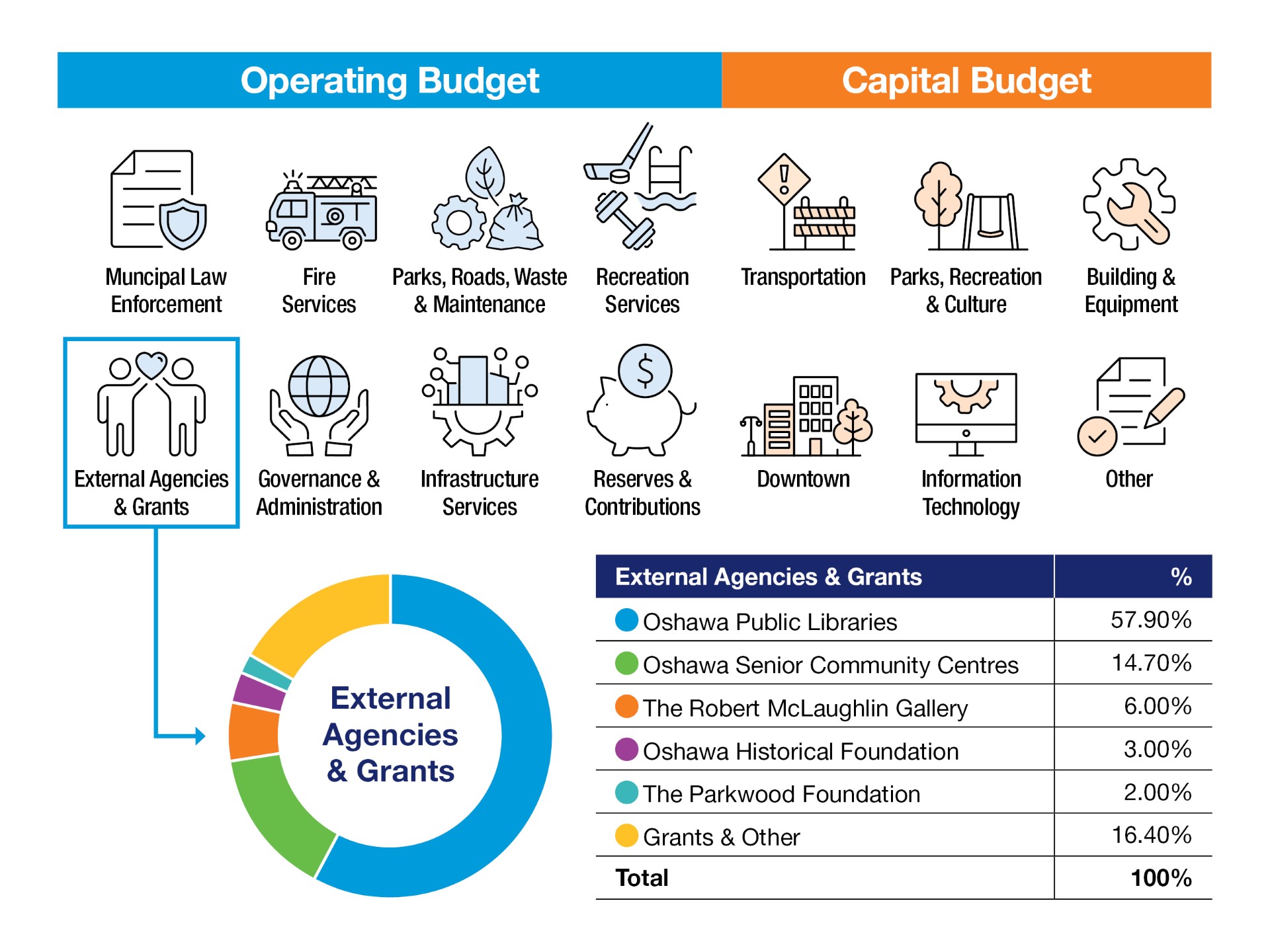
$16.8 million (includes $2.5 million of in-kind services) to support the following external agencies and organizations:
- Oshawa Senior Citizens Centres
- The Robert McLaughlin Gallery
- Parkwood National Historic Site
- Oshawa Tourism (through the Greater Oshawa Chamber of Commerce)
- Oshawa Historical Society
- Oshawa Public Libraries
Although Housing, Homelessness, Mental Health, Addiction and Social Services are the responsibilities of the Region of Durham as legislated by the Province, the City invests over $5 million annually to address health and safety concerns. Examples of these programs and measures include:
- a specialized Fire Response Unit that responds to 3,000 medical calls yearly
- increased Security and By-law costs
- increased costs to clean up garbage, human waste, used syringes and to remove graffiti in the downtown
- providing community improvement grants to help businesses make investments in crime prevention through environmental design and repairs to property
Financial Highlights
Where does the money come from?
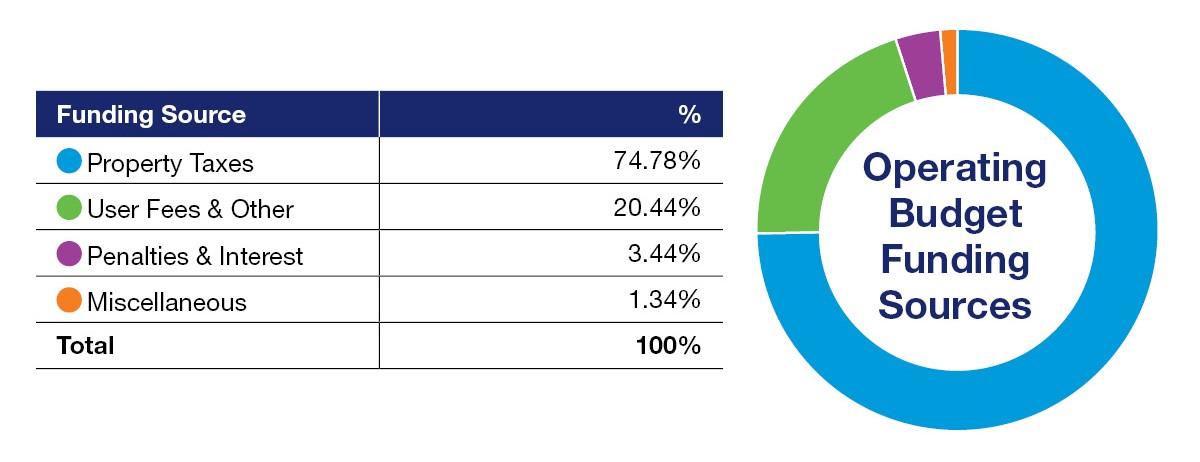
Property taxes will fund approximately 76.8% of the 2026 Operating Budget, with the remainder funded through other sources like user fees, program revenue, licences and permits, penalties and interests, and miscellaneous revenue.
What does my property tax bill pay for?
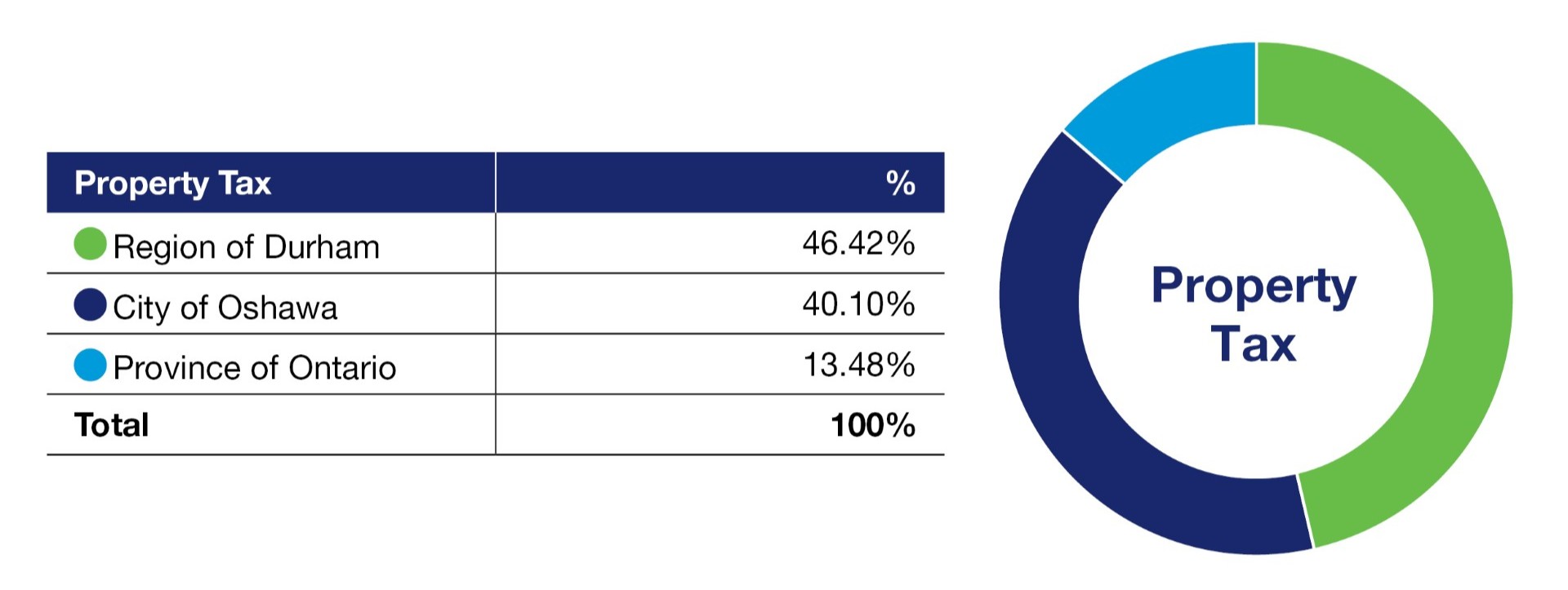
As a lower-tier municipal government, the City of Oshawa collects property taxes for not only itself, but also on behalf of the Regional Municipality of Durham (an upper-tier municipality) and the Province of Ontario.
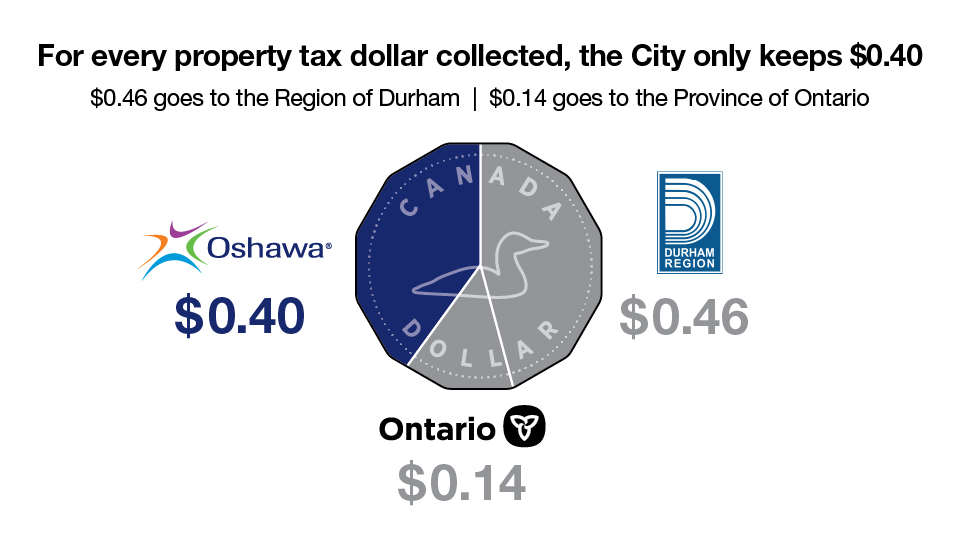
For every dollar the City collects in 2026, it will only keep approximately $.40.
Investing in our community
The City’s budget is made up of operating and capital budgets. Together, they balance competing priorities and challenges while providing affordable services and programs. The Budget invests in our city by maintaining and building infrastructure (like roads, sidewalks, trails and parks) and saves for the future by increasing reserve balances to ensure the financial health and sustainability of the city.
For $0.25 per day, the City provides the average assessed Oshawa property* with the following services:
Budget Levy vs Tax Rate
Did you know?
Your property tax bill is made up of three main components:
- Municipal Taxes
This tax rate covers the cost of supplying municipal services, which is driven by the City’s budget levy. - Regional Taxes
These taxes are based on the tax rate adopted by the Region of Durham for services including transit, housing, shelter, public health and emergency services. - Provincial Taxes
This portion is remitted to the Province of Ontario for education.
What's a Tax Rate?
The percentage applied to property assessments to collect the remaining amount needed. This rate changes based on property values and is separate from the Regional and Provincial portions.
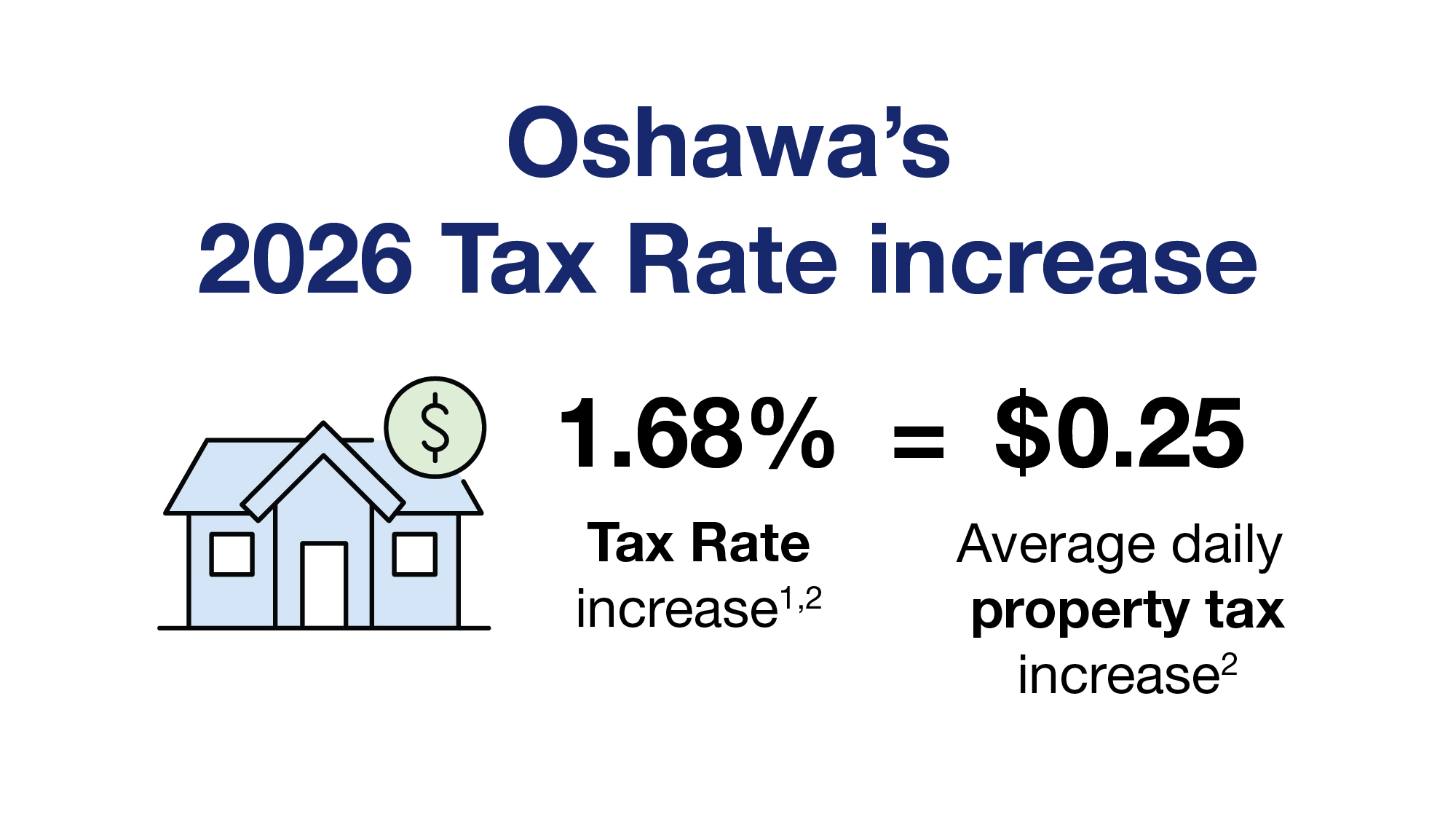
For 2026, this equates to a Tax Rate increase of 1.68% (or approximately $0.25 daily) for the local Oshawa share of the average household’s property tax bill.
1 Based on the proposed 2026 Region of Durham Property Tax Guideline increase of 4.80%.
2 Based on the City Portion of the Tax Rate increase, which is equivalent to approximately $0.25 daily for Oshawa’s portion of an average household property tax bill.
Get a breakdown of your property tax bill
Property Tax Calculator
See how much City programs and services are costing you by entering your Oshawa address into the City’s Property Tax Calculator.
The Property Tax Calculator has been updated for 2026!
This handy tool gives you a personalized estimate of how your property tax dollars are split up. As a two-tier municipality, the City collects taxes not just for itself, but also for the Region of Durham and local school boards on behalf of the Province.
Did you know that for every dollar collected in 2026, the City keeps about 40 cents, while 46 cents goes to the Region and 14 cents to the Province.